Manufacturing & RFQ
UI/UX Design
SEO & Growth
Feb 14, 2026
Generic Web Designer vs. Industrial Manufacturing Web Designer: The ROI Difference
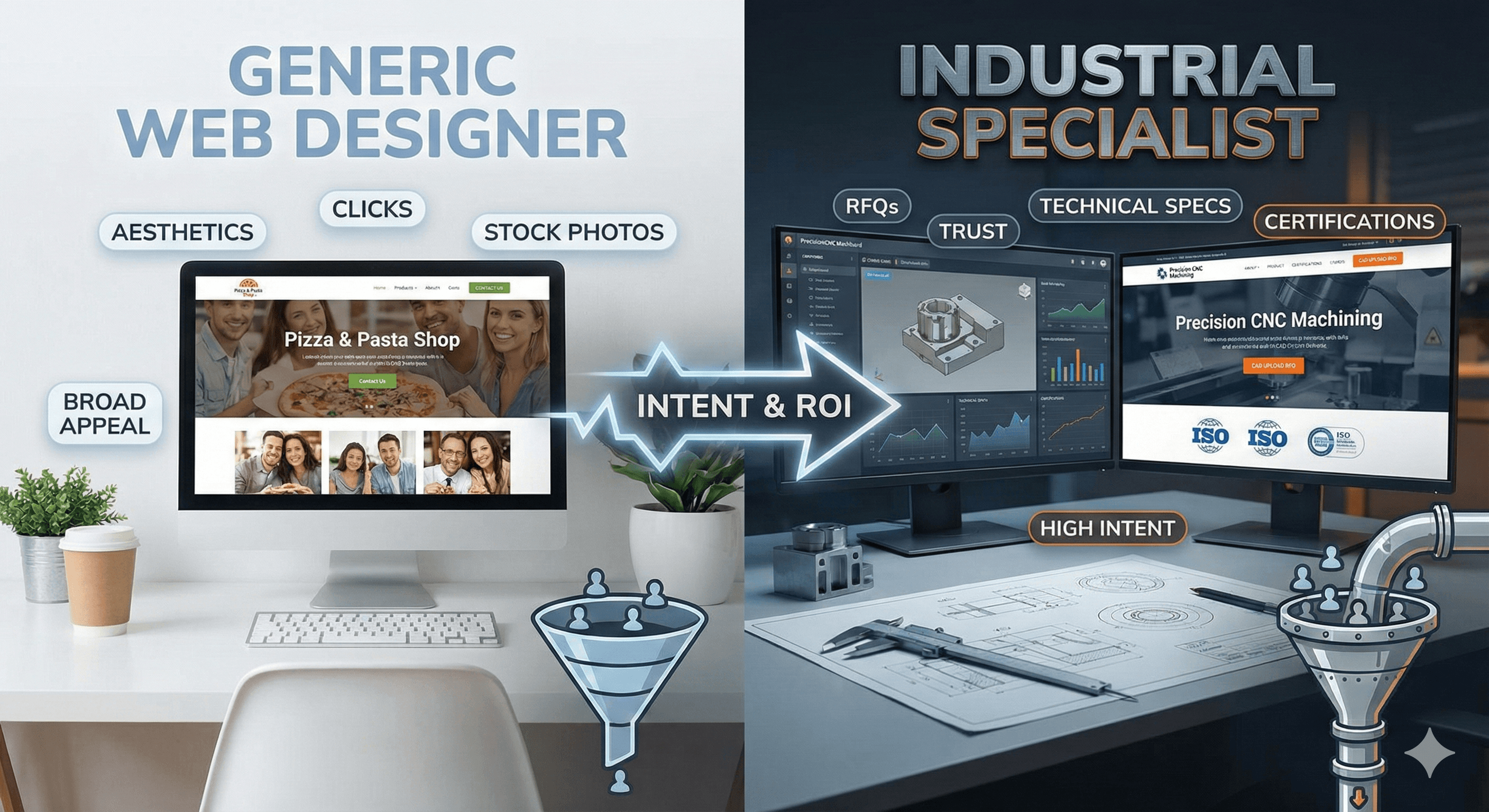
The difference between a Generic Web Designer and an Industrial Manufacturing Web Designer is Intent. A generic designer builds websites to "look good" and appeal to a broad audience. An industrial specialist builds digital infrastructure designed to speak the technical language of engineers and procurement managers. While a generalist focuses on clicks, a manufacturing specialist focuses on RFQs (Requests for Quote) and lowering the friction of complex B2B sales cycles.
The "Pizza Shop" vs. "The Machine Shop"
Most manufacturers make the mistake of hiring a local agency that builds websites for pizza shops, law firms, and dentists.
While these agencies can make a website "look" modern, they fundamentally misunderstand the B2B industrial buyer.
Generic Goal: "Get someone to call."
Industrial Goal: "Get a qualified engineer to upload a CAD file."
Here is the breakdown of why hiring a generalist is a liability for your factory.
1. Visual Strategy: Stock Photos vs. Shop Floor Reality
The Generic Designer:
Uses polished stock photos of "business people shaking hands" or "clean men in hard hats pointing at blueprints."
The Result: Real engineers immediately identify the site as inauthentic. If the "worker" in the photo is holding a wrench wrong, you lose credibility instantly.
The Industrial Specialist:
Demands high-resolution video of your actual machines (Mazak, Haas, Trumpf) in action.
Highlights "grit" and authenticity. They know that a pile of metal shavings (chips) proves you are actually working.
The Result: Builds instant Trust. The buyer sees capacity and capability, not just "marketing."
2. The Conversion Engine: Contact Us vs. Smart RFQ
The Generic Designer:
Builds a standard "Contact Us" page with Name, Email, and Message fields.
The Problem: This creates friction. A buyer has technical specs, drawings, and deadlines. A text box isn't enough.
The Industrial Specialist:
Builds a dedicated RFQ Engine.
Includes drag-and-drop zones for STEP/IGES/PDF files.
Includes secure checkboxes for NDA/ITAR compliance.
Asks specific questions: "Material Grade," "Surface Finish," "Estimated Annual Usage (EAU)."
The Result: You get Actionable Leads, not just "hello" emails.
3. Content & SEO: Fluff vs. Technical Specs
The Generic Designer:
Writes copy like: "We are dedicated to quality and innovation."
Targets keywords like: "Best Machine Shop."
The Problem: Every shop says they are "dedicated to quality." It means nothing. And "Best Machine Shop" is too competitive to rank for.
The Industrial Specialist:
Writes copy like: "AS9100 Certified Precision Machining with +/- .0005" Tolerances."
Targets keywords like: "5-Axis Titanium Machining Services USA."
The Result: Captures High-Intent Traffic. The person searching for specific tolerances is ready to buy now.
Comparison Table: At a Glance
Feature | Generic Web Designer | Industrial Specialist |
Primary Goal | Aesthetics / Brand Awareness | RFQ Generation / Sales Support |
Target Audience | General Public / B2C | Engineers / Procurement Managers |
Key Content | "About Us", Blog, Gallery | Equipment List, Certifications, Case Studies |
Call to Action | "Contact Us", "Learn More" | "Upload Drawings", "Get a Quote" |
SEO Focus | High Volume / Broad Terms | Low Volume / High Intent (Long-tail) |
Knowledge Base | Colors, Typography, Layout | Materials, Tolerances, ISO Standards |
4. The "Trust Signals" (Certifications)
A generic designer treats an ISO 9001 or AS9100 logo like a decoration. They might stick it in the footer, tiny and unreadable.
An Industrial Manufacturing Web Designer knows that certification is your passport to business.
They place the ISO badge in the Header (above the fold).
They create a dedicated "Quality" page where the actual certificate PDF is downloadable (because procurement needs to save it).
They understand that for Medical (ISO 13485) or Auto (IATF 16949) buyers, the site is irrelevant without that proof upfront.
The Bottom Line
If you are selling $50 sneakers, hire a generic designer. If you are selling $50,000 production runs, hire a specialist.
Your website is your 24/7 Sales Engineer. Do not hire a generalist to do a specialist's job.
FAQ: Quick Answers
Q: Why is industrial web design more expensive?
A: It requires strategic consulting. You aren't just paying for code; you are paying for a partner who understands your supply chain, your sales process, and your buyer's psychology.
Q: Can a generalist agency learn my industry?
A: Yes, but you will pay for their education. You will spend hours explaining what a "BOM" is or why "tolerances" matter. A specialist hits the ground running.
Q: How do I identify a true specialist?
A: Look at their portfolio. If they have case studies featuring "ERP Integration," "Distributor Portals," or "Part Catalogs," they are the real deal.