Manufacturing & RFQ
UI/UX Design
SEO & Growth
Feb 14, 2026
The Anatomy of a High-Converting Manufacturing Product Page
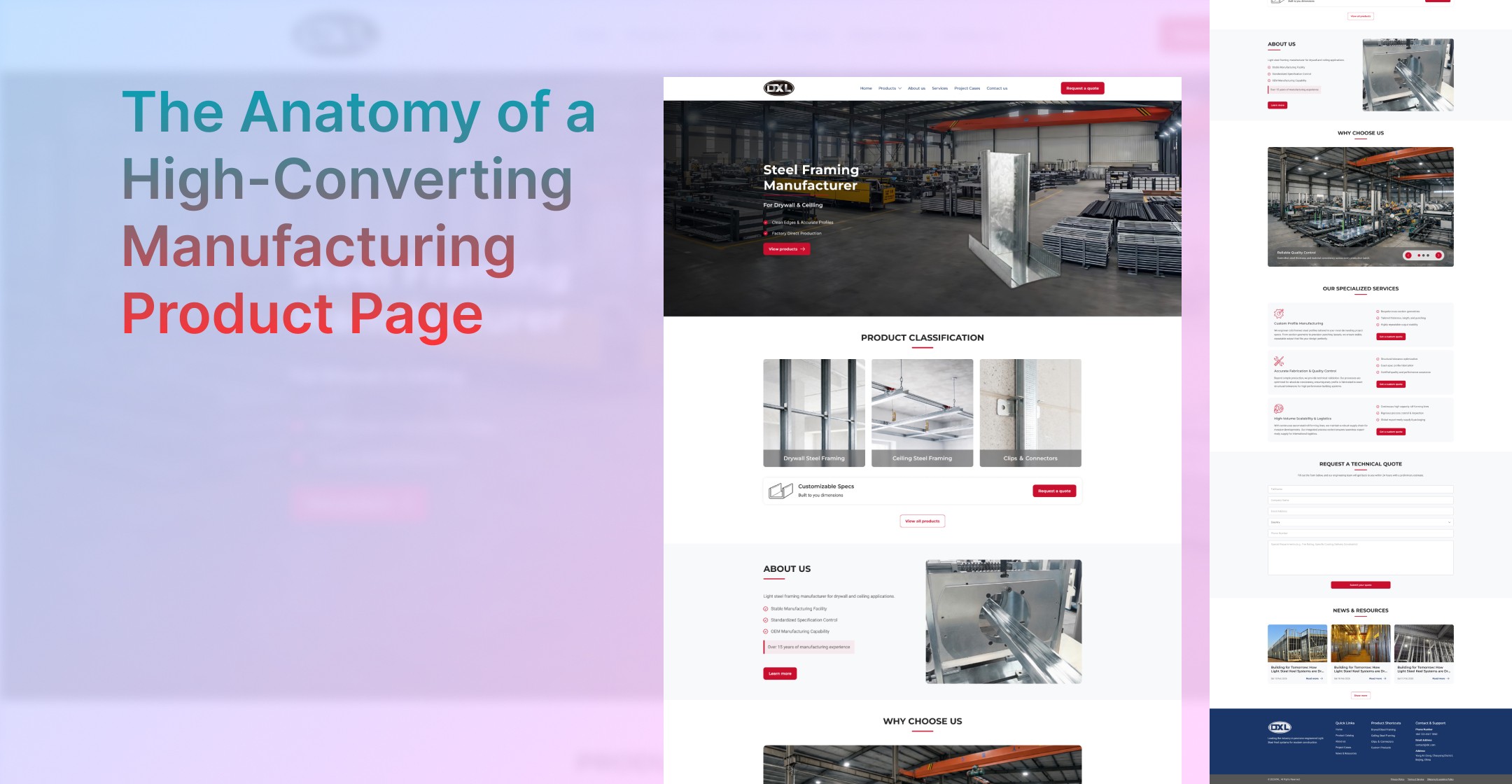
A high-converting manufacturing product page acts as a 24/7 Sales Engineer. It must instantly answer three questions: "Can you make it?", "Do you have the capacity?", and "Are you certified?" To rank on Google and convert engineers, the page must replace static PDFs with interactive HTML data tables, offer downloadable CAD files, and feature a clear, multi-step Request for Quote (RFQ) engine above the fold.
The Problem: The "PDF Graveyard"
Most manufacturing websites make a fatal mistake: they treat their product pages like digital brochures.
You upload a PDF spec sheet, add a "Contact Us" button, and hope for the best. This fails for two reasons:
Google can’t read PDFs well. It doesn't index the individual specs inside the document, so you don't rank for specific part numbers or materials.
Engineers hate friction. If they have to download a file just to check a tolerance or material grade, they will bounce to a competitor who displays that data right on the screen.
Here is the blueprint for a product page that actually generates RFQs.
1. The Hero Section: The "3-Second Rule"
When a procurement manager lands on your page, they are in a rush. They don't want to read a paragraph about your "commitment to excellence." They want facts.
The "Above the Fold" Layout:
Headline: The specific name of the service/machine (e.g., "5-Axis CNC Titanium Machining" not just "Machining").
Sub-Headline: Key capacity limits (e.g., "Tolerances to +/- .0005" | Runs from 1 to 10,000 units").
Visual: A high-resolution photo or video of the part being made (not a stock photo of a handshake).
Primary CTA: A high-contrast button that says "Request a Quote" (not "Contact Us").
2. The "Meat": HTML Data Tables (SEO Gold)
Stop burying your technical data in PDFs. You must extract that data and build it into HTML Tables directly on the page.
Why? When a user searches for "316L Stainless Steel Tensile Strength," Google scrapes HTML tables to build "Featured Snippets" (Position Zero). If your data is trapped in a PDF, your competitor gets that snippet.
What to include in the table:
Material compatibility.
Min/Max dimensions.
Surface finish options (Ra).
Lead times (Standard vs. Expedited).
3. The "Engineer’s Candy": Downloadable Assets
Engineers are your primary influencers. Give them the tools they need to spec you into their drawings.
CAD Files: Allow them to download STEP or IGES files of standard parts.
Calculators: Embed a simple "Metal Weight Calculator" or "Bend Allowance Calculator."
White Papers: "Design Guide for Injection Molding" (Gate this content to capture their email).
4. The Trust Bar: Certifications & Logos
In B2B manufacturing, trust is binary. You are either certified or you are a risk. Place your "Trust Bar" immediately below the Hero section.
Must-haves:
ISO Badges: (ISO 9001, AS9100, IATF 16949). Don't hide these in the footer.
ITAR / NIST: If you do defense work, these logos are mandatory.
Client Logos: "Trusted by Boeing, Tesla, GE." (Social Proof).
5. The Conversion Engine: The "Smart" RFQ
The generic "Contact Us" form is the enemy of revenue. Your product page needs a dedicated, context-aware RFQ section.
The "Smart" Form Strategy:
File Upload: A massive drag-and-drop zone for drawings (Must accept 50MB+).
Dynamic Logic: If they select "Turnkey Assembly," a new field should appear asking, "Do you need packaging?"
NDA Checkbox: "I require an NDA before uploading." (This single checkbox increases conversions by ~20%).
6. Technical SEO: The Hidden Layer (Schema)
To the human eye, the page looks great. To the Google bot, it needs to look structured. We implement Product Schema and Service Schema code on every page.
This tells Google:
"This is a Service."
"These are the Reviews (Stars)."
"This is the Price Range."
This is how you get those rich "Star Ratings" to appear next to your link in Google search results, increasing your click-through rate.
The Bottom Line
Your product page is not a gallery; it is a tool. If it doesn't help an engineer do their job faster, it is obsolete.
Is your current product page driving leads or collecting dust?
Ferdaus Tech specializes in turning brochure websites into high-performance industrial sales engines.
Click here to get a free audit of your top product page.